


By Dan Woods, Saunass sauna specialist · Sources: heater maker manuals and guidance, Finnish sauna research, US EPA wood burning advice, and what owners share online
Published October 29, 2026 · Last updated October 29, 2026
Quick Answer: What Is a Wood-Fired Sauna?
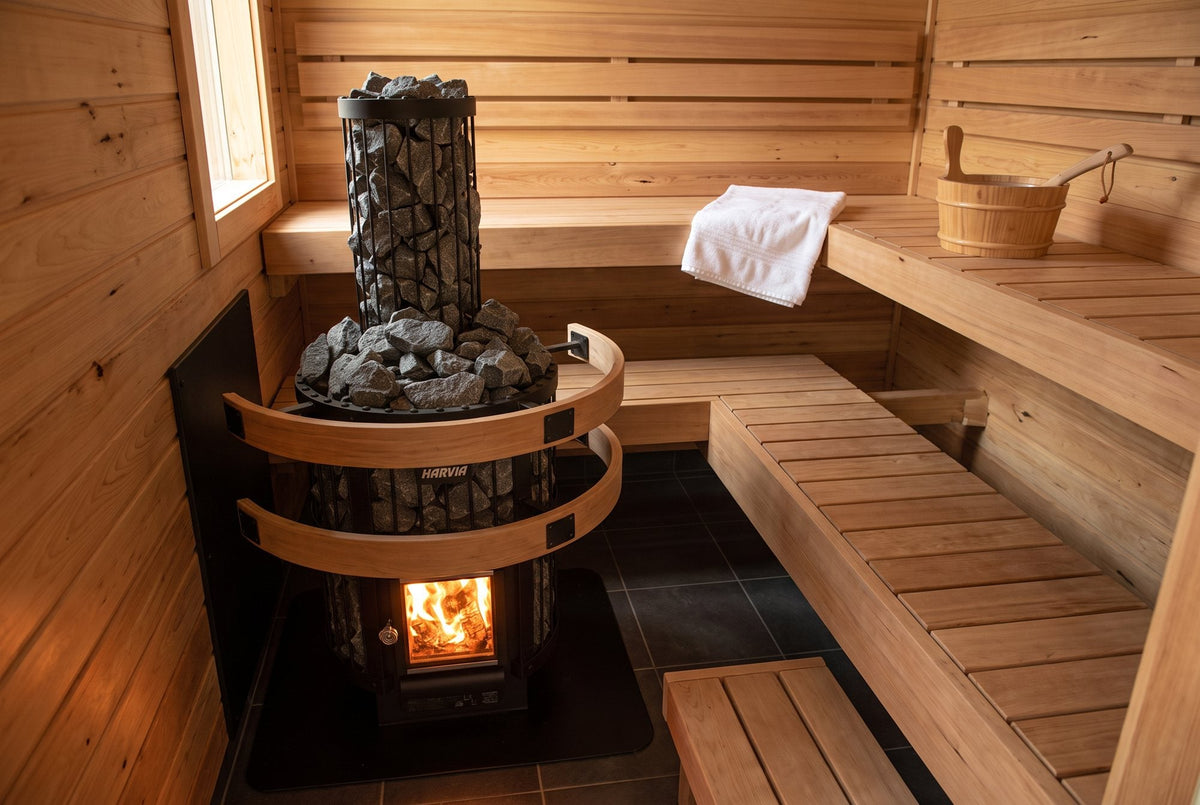
A wood-fired sauna is a traditional sauna heated by a wood burning stove instead of an electric heater. You build a fire in the firebox. The fire heats a steel body and a basket of sauna stones on top. Smoke leaves through a chimney, and the hot stones heat the room and give soft steam when you add water.
It is the classic Finnish way to bathe, and it needs no electrical hookup. The trade-off is work: a sauna rated chimney, dry firewood, and a fire to tend. If that sounds like part of the fun, start with our wood burning sauna stoves. If you want push button heat, look at electric sauna heaters instead.

How Does a Wood-Burning Sauna Work?
Think of a very hot room stove with a pile of rocks on top. Here is the flow.
- Fire in the firebox. Logs burn in a steel chamber with a door and an ash box below. Opening the ash box a little feeds air to the fire.
- Heat into the stones. The fire heats the stove body and the stones that sit around and above it. The stones store that heat.
- Heat into the room. Hot air rises off the stove and circulates. Fresh air comes in low near the stove, and a vent high on the far side lets moist air out.
- Smoke up the chimney. Flue gas leaves through a sealed chimney. Finnish sauna researcher Lassi Liikkanen notes that exhaust from some sauna stoves can reach about 700°C (roughly 1,290°F).
- Steam from the stones. Ladle water on the hot stones and you get a burst of steam, called löyly in Finnish.
Most stoves sold today are continuous stoves. The fire stays separate from the stones, so you can keep burning while you bathe.
Stone amount shapes the steam. Harvia says heaters with more stones give softer, fuller steam, while fewer stones give a sharper, harder steam. If you are new to steam, our guide to dry vs wet sauna explains how water on the stones changes the room.

Wood-Fired or Electric Sauna?
Pick wood if you love fire, live off the grid, or want a cabin feel. Pick electric if you want easy heat on a weeknight. Liikkanen calls electric stoves the most versatile choice for frequent use where the grid reaches. They have timers and temperature control. Wood stoves are more demanding: you handle firewood, empty ashes, add logs, and watch for burns and fire risk.
| Wood-fired sauna | Electric sauna | |
|---|---|---|
| Power needed | None. Burns firewood | Usually a dedicated circuit and a licensed electrician |
| Chimney | Required, sauna rated | Not needed |
| Control | You tend the fire and the ash box | Thermostat, timer, often remote control |
| Daily work | Firewood, ash removal, adding logs | Press a button |
| Feel | Fire glow, crackle, soft steam with big stone loads | Even, steady heat |
| Best for | Cabins, off grid, fire lovers | Frequent weeknight use at home |
Heat-up time is part of the choice. Harvia says an electric heater runs at full power for the first 30 to 40 minutes, and a typical family sauna heats for about an hour. With wood, many owners online plan for about an hour, longer on a cold day.
What Is the Best Wood-Burning Sauna Stove?
The best wood burning sauna stove is the one sized for your room, with the stone amount and features you want. Harvia's buyer checklist starts with the same steps:
- Measure the room volume. Multiply length by width by height, using the highest point of a sloped ceiling. A 6 x 7 x 7 ft room is 294 cubic feet.
- Size for your climate. Harvia says an outdoor sauna in a cold climate needs more heating capacity to cover heat loss.
- Choose your steam. More stones give softer steam. Fewer stones heat faster and feel sharper.
- Pick your features. A glass door, a water tank, or a firebox you feed from outside the hot room.
Here is how the stoves in our collection line up. All are made by Harvia in Finland.
- Best value for a small to mid room: the Harvia M3 is 16.5 kW for 160 to 460 cubic feet. It takes about 90 lbs of stones, sold separately.
- Best for soft steam: the Harvia Legend 150 is 16 kW for 212 to 459 cubic feet and holds up to 264 lbs of stones.
- Best for larger rooms: the Harvia Pro 20 covers 283 to 706 cubic feet. For big rooms and lower emissions, the Legend 240 GreenFlame covers 353 to 848 cubic feet with 440 lbs of stones. Harvia says its fire chamber cuts carbon monoxide emissions by up to 70%.
- Best for a clean hot room: the Harvia M3 SL lets you feed the fire from the next room or outside, so ash and logs stay out of the sauna.
- Best for a cabin without running hot water: the Harvia Pro 20 ES has a 20 liter (about 5 gallon) water tank that warms as the sauna heats. Harvia warns the tank must never be empty while you heat.
Check each stove's minimum room height and safety distances before you buy. They vary by model.

Do You Need a Chimney for a Wood-Fired Sauna?
Yes. Harvia states plainly that a chimney is required. It carries smoke and gases out and keeps the fire drawing well. It must follow local building codes for height, materials, and clearances.
Use a chimney made for sauna stoves. Harvia's manual for the M3 and Pro 20 calls for a T600 temperature class chimney, rated for continuous use at 600°C. It also says the stove is not suitable for a shared flue. Liikkanen points out that steel flues are light and easy to fit, but DIY builders who skipped T600 rated parts have caused serious fires in Finland.
Our Harvia WHP1500 stainless steel chimney and the black WHP1500M are built for wood heated stoves in detached sauna buildings. Find them, plus stones, floor protection, and other parts, in heater accessories.
A few more rules from the Harvia manual:
- Keep the stove's safety distances to walls, benches, and the ceiling. Protective sheaths can shrink them.
- Put the stove on a floor that can carry its weight. A tile or wood floor needs protective bedding, such as the Harvia WL100.
- Place the fresh air inlet low near the stove and the outlet high, as far from the stove as you can.
Call your local building office first. Harvia notes that some areas limit or ban wood burning heaters, or require permits or a professional installer.

Can You Put a Wood Stove in a Barrel Sauna?
Yes, if the barrel's maker designed it for one. Many outdoor wood burning saunas are barrels. Dundalk Leisurecraft, for example, sells its cedar barrels with an optional wood stove kit. Its instructions add a floor heat shield and a rear wall heat shield. You cut an 8 inch hole in the top, run an insulated chimney through it, and seal a roof boot with roofing screws. Vents go low on the back wall and high on the front.
That kit is made for that barrel. Never cut a chimney hole in a barrel built only for electric heat.
The barrel saunas we carry ship with electric heaters or are built for them. The Sweat Barrel is a good example. If you want wood heat in a barrel, ask us before you order. We will tell you which models the maker approves for wood. For cabins and other styles, browse our outdoor saunas and read our outdoor sauna plans guide.

What Firewood Should You Burn?
Burn dry, clean hardwood. Harvia names birch and alder as the best sauna firewood, because they burn well with steady heat and little smoke. Dry wood clinks when you knock two pieces together.
The US EPA gives clear numbers:
- Wood burns best below 20% moisture. Test it with a moisture meter.
- Season softwood for at least six months and hardwood for at least a year.
- Stack it outdoors, off the ground, with only the top covered. Covering the sides traps moisture.
Never burn painted or treated wood, plywood, chipboard, plastic, garbage, pellets, coal, or garden waste. Harvia also warns that burning a lot of high heat wood shortens a stove's life. You need 15% less beech than birch to get the same heat. For wall and bench lumber, see our guide to the best wood for a sauna.

How to Heat a Wood-Fired Sauna
This is the routine from Harvia's M3 and Pro 20 manual.
- Empty the ash box. Ash blocks the air the fire needs.
- Load the logs. Put the biggest pieces at the bottom and smaller ones on top. Use logs about 3 to 5 inches (8 to 12 cm) across, with room for air between them.
- Light from the top. Set kindling on top of the logs. Harvia says a top lit fire makes fewer emissions.
- Close the door. Control the draft by opening the ash box a little. The stove is not meant to run with the door open.
- Add a few logs as needed. Once the room is hot, a couple of pieces keep bathing temperature.
Do not overdo it. Harvia warns that several full loads in a row can overheat the sauna, stove, and chimney and create a fire risk. Its rule of thumb is that over 100°C (212°F) is too hot for a sauna. Our sauna temperature guide covers the comfortable range.
Safety and Upkeep
A wood heated sauna needs a little care each time and a check every year.
- After every use: empty the ash pan, Harvia says. The EPA advises putting ashes in a covered metal container, stored outdoors on a surface that cannot burn.
- Every year: have the chimney inspected and cleaned, and rearrange the stones. Replace cracked or crumbling ones.
- Always: keep a fire extinguisher close. The EPA recommends smoke and carbon monoxide alarms on every floor of the house and outside each bedroom.
If the chimney ever catches fire, Harvia's manual says to close the ash box, stove door, and damper, call the fire department, and never use water.
Checklist
- Decide if you want the fire ritual or push button electric heat.
- Check local rules on wood burning, permits, and installers first.
- Measure your room volume in cubic feet.
- Pick a stove rated for that volume and your climate.
- Choose stone capacity for the steam you like.
- Buy a sauna rated, T600 class chimney and the right ceiling or roof parts.
- Plan floor protection and the stove's safety distances.
- Only add a wood stove to a barrel the maker approves for wood.
- Burn dry hardwood under 20% moisture.
- Empty ashes into a covered metal can and inspect the chimney every year.
Wood-Fired Sauna: FAQ
Quick answers to the questions buyers ask most about wood-fired saunas. Tap a question to open it.
What is a wood-fired sauna?
A fire in the firebox heats the stove body and a load of sauna stones. The stones heat the room and make steam when you add water, and smoke leaves through a chimney.
How does a wood-burning sauna work?
Fresh air enters low near the stove and moist air leaves through a vent high on the far side. Most modern stoves are continuous stoves, so you can add logs while you bathe.
What is the best wood-burning sauna stove?
In our range, the Harvia M3 suits small to mid rooms, the Legend 150 gives soft steam with up to 264 lbs of stones, and the Pro 20 or Legend 240 GreenFlame suit larger rooms.
Is a wood-fired or electric sauna better?
Electric heaters have timers and temperature control and need no chimney. Wood stoves need firewood, ash removal, a sauna rated chimney, and more attention while you bathe.
Do you need a chimney for a wood-fired sauna?
Use a chimney made for sauna stoves. Harvia's manual for the M3 and Pro 20 calls for a T600 class chimney and says not to share a flue. Local codes set height and clearance rules.
Can you put a wood stove in a barrel sauna?
Barrels built for wood use heat shields, an insulated chimney through the roof, and a sealed roof boot. Do not convert an electric only barrel on your own. Ask us which models allow wood heat.
What firewood is best for a sauna stove?
The EPA advises seasoning softwood for at least six months and hardwood for at least a year. Never burn painted or treated wood, plywood, plastic, or garbage.
How long does a wood-fired sauna take to heat up?
Heat-up time depends on room size, insulation, stone mass, and how dry your firewood is. A stove sized correctly for the room and dry wood make the biggest difference.
Fire safety and building disclaimer: This article is general information, not building, fire safety, or medical advice. Stove clearances, chimney rules, and permits vary by product and location. Follow your stove and chimney manuals, your local building and fire officials, and a qualified installer.
Next step: Not sure if wood or electric fits your home? Take the Sauna Finder Quiz, browse wood burning sauna stoves or outdoor saunas, or call us at (307) 222-0551. You can also email info@saunass.com.


